It's 9:01 AM on listing day. Your IPO allotment (the one that wasn't actually guaranteed by applying for more lots) finally came through, the app shows a green number, and your thumb is hovering over Sell, ready to fire the second the price looks good. You refresh. Nothing moves the way it does on a normal trading day. You refresh again. Still nothing.
That's not a bug. That hour genuinely doesn't work like the rest of the market, and once you know why, you can stop refreshing.
Why It Feels Like a Race
On every other trading day, buying and selling is continuous. The instant the market opens, prices move tick by tick as real orders hit a live order book, so it's completely reasonable to assume a freshly listed stock works the same way. Fast reflexes help in that world. You've probably heard someone brag about "catching the top" on a stock they were watching, which only makes sense if trading is a live race between everyone's timing.
Listing day breaks that assumption for exactly one hour, and it happens to be the one hour that decides your price.
What's Actually Happening for That One Hour
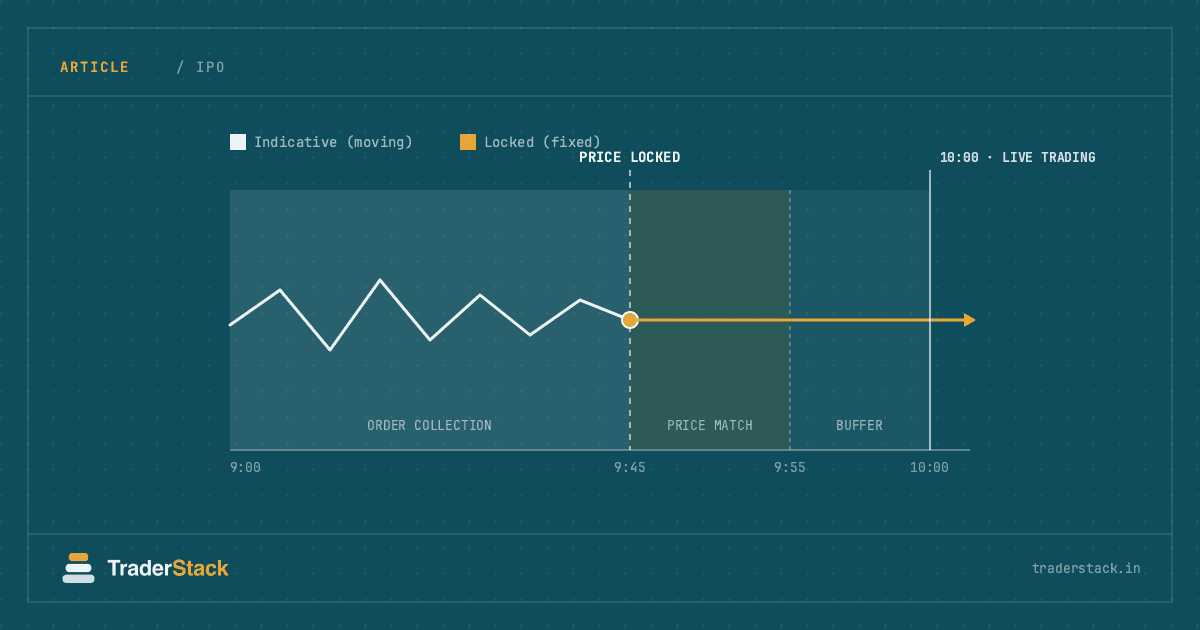
Between 9:00 AM and 10:00 AM on an IPO's first trading day, the exchange runs what's officially called a special pre-open session: a call auction, not live trading. Every buy and sell order placed in that window gets collected quietly, with no visible order book and no running trade-by-trade ticker.
Roughly the first 45 minutes (9:00 to 9:45) is just order collection. Somewhere around 9:45 to 9:55, the exchange takes every order that came in and works out one number: the price at which the largest number of shares can actually change hands, called the equilibrium price. If two prices would clear the same volume, whichever leaves fewer unmatched shares wins; if that's still tied, the price closest to the issue price wins. A short buffer (9:55 to 10:00) follows before continuous trading takes over at 10:00 AM.
That equilibrium price can't land anywhere it wants, either. Exchanges cap the session with a dummy price band: for a regular mainboard IPO, that's currently -50% to +100% of the issue price, a wide range, but a range all the same. SME IPOs get an even wider -90% to +90% band, which is one of several reasons SME listings run on a different, riskier rulebook than mainboard ones. Relisted stocks get -85% to +50%. None of that changes the basic fact: only one price gets picked inside whatever range applies, once, at the end of the window.
Key takeaway
For that first hour on listing day, there's no live price to chase. Every order gets pooled together, and the exchange calculates a single price only once the window closes: whichever price lets the most shares actually trade.
One detail that trips people up: the number your app shows through that hour, ticking up or down as orders arrive, is only a running estimate of where the price might land if the window closed right now, not something you can actually trade at yet.
Think of It Like a Sealed Auction, Not a Ticker
Here's a cleaner way to hold the idea: picture a sealed-bid auction instead of a stock ticker. Everyone who wants in writes their price on a slip of paper and drops it in a box between 9:00 and 9:45. Nobody sees anyone else's slip. Nobody knows the running "best price," because there isn't one yet, just a box slowly filling up.
At 9:45, the box gets opened. Every slip gets read together, and the auctioneer announces one number: the price that clears the most paper. Whether your slip went in at 9:01 or 9:44 makes no difference to what price you get. The box doesn't care about order of arrival. It only cares what's inside it once it's opened.
A Real Listing Day, Rupee for Rupee
Say a shop owner in Coimbatore applied for an IPO priced at ₹450 a share and got allotted one lot, 33 shares, credited to their demat account the evening before listing. A cousin in the trading WhatsApp group had spent the week forwarding "GMP is at ₹150" messages, GMP being the unofficial grey-market price everyone quotes before a stock lists, which worked out to an expected opening around ₹600. Naturally, the shop owner wants to sell fast and use the gain to restock inventory before the festival season.
At 9:00 AM, they place a market order: no price attached, just sell at whatever the auction decides. Through the collection window, the indicative price on their app jumps around, ₹580, then ₹615, then back to ₹590, recalculating with every new order that lands. At 9:45, the window closes. Enough sellers show up wanting to book profit that the actual equilibrium price settles at ₹590, not the ₹600 the group chat promised. The order fills at ₹590 for all 33 shares: a real gain of roughly ₹4,620 over the issue price, useful money, just not the exact figure a WhatsApp forward guessed at.
Now picture a second investor in the same IPO who got greedy and placed a limit order instead: "sell, but only at ₹650 or better." When the auction closes at ₹590, that order doesn't fill. It doesn't vanish either; it carries over into the 10:00 AM continuous session, where it now has to compete in a live order book instead of a guaranteed single-price auction. Sometimes that works out fine. Sometimes the stock never touches ₹650 again and the order just sits there all day. That's the actual choice listing day gives you: take the auction's price with a market order, or hold out for a better one with a limit order and accept you might be waiting.
What People Get Wrong
Placing your sell order the second the session opens at 9:00 gets you a better price than placing it at 9:40.
Timing inside the window doesn't matter. The exchange computes one price from every order together, only after the window closes.
Setting a high limit order guarantees you'll get that price if the stock is worth it.
A limit order above the auction's equilibrium price simply doesn't fill. It rolls into the 10 AM continuous session and has to compete there instead.
Where to Go From Here
Everything above assumes you already have a rough number in mind for what a stock should open at, and that number almost always comes from GMP chatter in the days before listing. That figure gets quoted with a lot of confidence for something traded in an unofficial market with none of the auction's rules. Worth knowing exactly how much to trust it, and where it's gone badly wrong before.