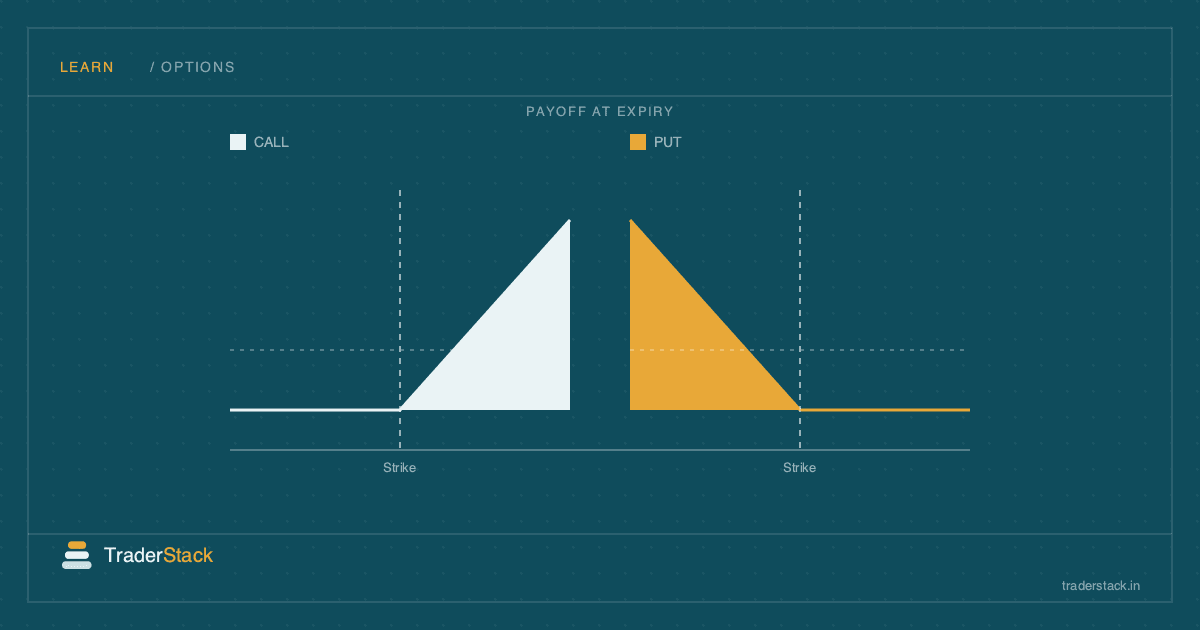
Every options strategy, no matter how complex it eventually gets, is built from just two contracts: a call and put option. A call gives the buyer the right to buy an asset at a fixed price. A put gives the buyer the right to sell it. That's the entire mechanical difference. Everything else, including who profits and who's at risk, follows from that one distinction. This page walks through both sides with real ₹ numbers, so the difference sticks instead of just sounding correct on a definitions page.
What's the Difference Between a Call and a Put Option?
A call option gives you the right to buy the underlying at a fixed strike price before expiry. A put option gives you the right to sell it at a fixed strike price before expiry. Buy a call when you expect the price to rise, buy a put when you expect it to fall. In both cases, your downside as a buyer is capped at the premium you paid.
Key takeaway: A call bets on the price going up, a put bets on it going down, but only for the buyer. Once you start selling options instead of buying them, the bias reverses and the risk profile changes completely.
Both contracts exist because traders want more than one way to express a view. Owning a stock only lets you profit if it goes up. Options let you pay a small amount upfront to profit from a move in either direction, or to protect a position you already hold, without ever needing to own or short the underlying itself.
Call Option Explained (With an Example)
A call option gives the buyer the right, not the obligation, to buy the underlying at a fixed strike price on or before expiry. You buy a call when you expect the price to go up. It's a way to profit from a rally by paying a fraction of what the asset itself would cost.
- Ananya sets up the trade. Nifty is trading around ₹24,800. Ananya, a long-term equity investor in Pune who's used to holding stocks outright, expects a rally over the next two weeks and buys 1 lot (65 units, Nifty's lot size at the time of writing — check the current figure before trading, since NSE revises it periodically) of the ₹25,000 call for a premium of ₹150 per share, a total outlay of ₹9,750.
- The market moves her way. Nifty climbs to ₹25,300 by expiry. Her call is now worth its intrinsic value: ₹300 per share (₹25,300 minus ₹25,000), or ₹19,500 for the lot.
- She squares off. Selling the call back nets ₹19,500 against a cost of ₹9,750, a profit of ₹9,750 before brokerage and taxes.
- If she'd been wrong. Had Nifty closed anywhere at or below ₹25,000, the call would expire worthless. Her loss would be capped at the ₹9,750 she paid, not a rupee more, no matter how far Nifty had fallen.
Put Option Explained (With an Example)
A put option gives the buyer the right, not the obligation, to sell the underlying at a fixed strike price on or before expiry. You buy a put when you expect the price to fall, or when you want to protect a position you already hold. Puts aren't only a bet on a stock dropping; they're also used as insurance.
- Irfan owns the exposure he's protecting. Irfan runs a textile trading business in Surat and holds 500 shares of a company at an average price of ₹1,400 each, a position worth ₹7,00,000 that he doesn't want to sell yet but is nervous about over the next month.
- He buys insurance, but only in whole lots. Stock options trade in a fixed lot size set by NSE per stock, not per trader, so Irfan can't buy puts on exactly his 500 shares unless 500 happens to be a multiple of that stock's lot size. At the time of writing this stock's lot size is 600 units, so the smallest position he can buy is 1 lot. He buys 1 lot (600 units) at a strike of ₹1,380, paying a premium of ₹25 per share, ₹15,000 in total, protecting 100 shares more than he actually owns.
- The stock falls. The price drops to ₹1,300. His 500 shares are down ₹50,000 in value (₹100 x 500), while his 600 puts are now worth ₹80 per share in intrinsic value (₹1,380 minus ₹1,300), or ₹48,000 for the position.
- The put absorbs most of the damage, and then some. Netting the puts' ₹48,000 payoff against the ₹15,000 he paid for them, the puts alone made him ₹33,000. Against the ₹50,000 loss on his shares, his effective loss comes to ₹17,000. Part of that extra cushion came from the 100 units of over-hedge, which had no shares underneath them to protect, so on those units he was quietly making a directional bet on the stock falling, not just insuring one.
Tip
Stock options only trade in whole lots, so a hedge almost never matches your exact share count. If your holding isn't a multiple of the lot size, you either round down and leave a small slice uncovered, or round up like Irfan did and end up slightly over-hedged.
Call vs Put Option: Side-by-Side
| Call Option | Put Option | |
|---|---|---|
| Right acquired (buyer) | Right to buy the underlying | Right to sell the underlying |
| Buyer's view | Bullish, expects the price to rise | Bearish, expects the price to fall, or wants downside protection |
| When it profits (buyer) | Price rises above strike plus premium paid | Price falls below strike minus premium paid |
| Buyer's maximum risk | Premium paid, and nothing more | Premium paid, and nothing more |
| Seller's maximum risk | Theoretically unlimited, since price has no ceiling | Large but capped, since price can't fall below ₹0 |
Buying vs Selling: Why the Bullish/Bearish Bias Flips
Buying a call is bullish and buying a put is bearish. That part is intuitive. What trips people up is selling: selling a call is a bearish-to-neutral bet, and selling a put is a bullish-to-neutral bet. The direction flips because the seller is taking the opposite side of the buyer's bet.
| Action | Position | Market view it expresses |
|---|---|---|
| Buy a call | Long call | Bullish |
| Sell a call | Short call | Bearish to neutral |
| Buy a put | Long put | Bearish |
| Sell a put | Short put | Bullish to neutral |
This is the single most common source of confusion for new options traders. People see "put" and assume it's always a bearish trade, when someone selling a put is actually hoping the price holds up or rises. Direction depends on both the contract type and whether you're buying or selling it, not on the word "call" or "put" alone.
Common Misunderstandings
Buying a put option is the same as short selling the stock.
Short selling carries theoretically unlimited loss. Buying a put caps your loss at the premium paid, and you never touch the underlying shares.
An option buyer's risk is just as large as the seller's.
The buyer's maximum loss is the premium paid. Sellers can face much larger losses, especially when writing uncovered calls.
You have to hold an option until expiry.
Most retail traders square off their position before expiry. You're not locked in, and most contracts are never exercised.