Priya has been investing in stocks for eight years. She reads a balance sheet without blinking, but the first time she opened Nifty's option chain on Zerodha, the numbers made no sense. Two calls, same expiry, strikes just 200 points apart. One cost ₹260, the other ₹70. Nobody at her desk could tell her why.
That gap isn't random. Every option premium is built from the same two ingredients, and once you can see them separately, the whole option chain stops looking like noise.
Key takeaway
An option's premium is intrinsic value plus time value. Intrinsic value is the money you'd pocket if you exercised the option right now, pure arithmetic based on where the spot price sits versus the strike. Time value is everything else: the market's bet on how much the price could still move before expiry, driven mainly by implied volatility and days remaining.
How Are Option Premiums Calculated
An option premium is calculated as intrinsic value plus time value. Intrinsic value comes straight from comparing the spot price to the strike price. No guessing involved. Time value is the part market makers price in for uncertainty: how volatile the underlying has been, how many days are left until expiry, and current interest rates.
Premium = Intrinsic Value + Time Value
- Intrinsic Value
- What you'd gain by exercising the option right now, never negative
- Time Value
- What the market pays for the chance the option becomes more valuable before expiry
Nothing else feeds into the price. A market maker quoting an option premium is really just running this formula thousands of times a second as the spot price and volatility shift.
The Option Premium Formula, Broken Down
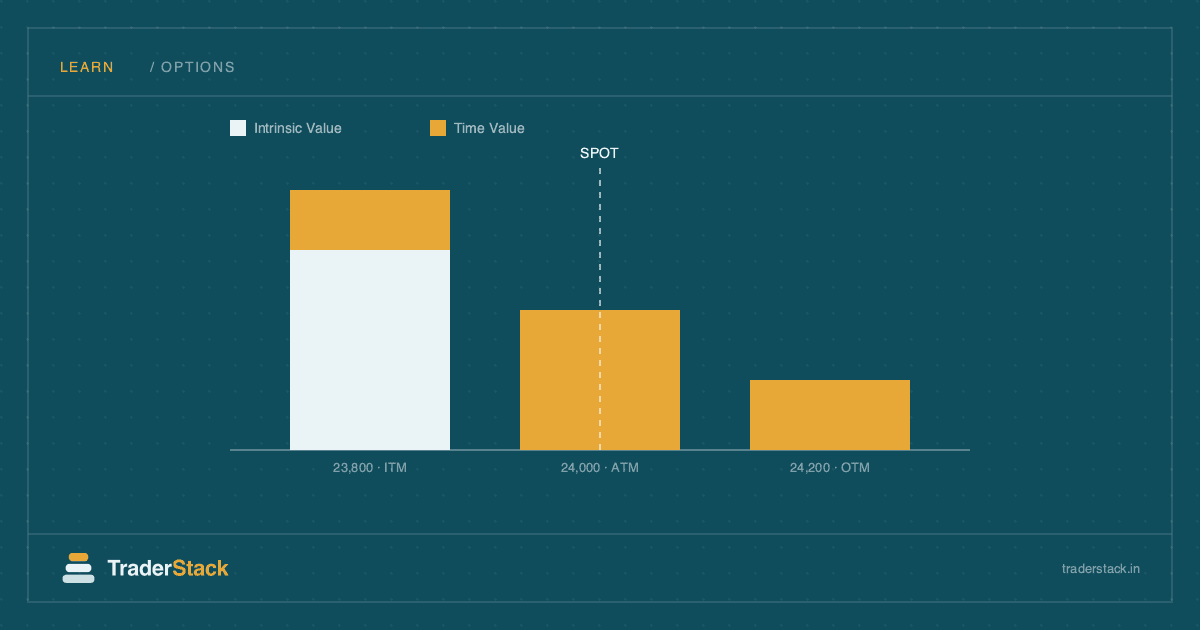
Here's Priya's actual situation, worked through. Nifty is trading at ₹24,000. She pulls up three call option strikes on the same expiry.
- She checks the ITM strike first. The 23,800 call is ₹200 in the money (24,000 − 23,800). The market quotes it at ₹260. That means ₹200 of the premium is intrinsic value and the remaining ₹60 is time value.
- She checks the ATM strike. The 24,000 call has a strike equal to spot, so intrinsic value is exactly ₹0. Yet it's quoted at ₹140. All of that is time value, because the market still sees a real chance it finishes in the money.
- She checks the OTM strike. The 24,200 call is out of the money: spot is below the strike, so intrinsic value is ₹0 here too. It trades at ₹70, cheaper than the ATM call, because a bigger move is needed for it to pay off. That entire ₹70 is time value as well.
- She converts to actual cost. Nifty's lot size is 75 at the time of writing — confirm the current figure before trading, since NSE revises it periodically. Buying one lot of that OTM call costs her ₹70 × 75 = ₹5,250, not ₹70. That's the number that hits her account, not the quoted premium.
| Strike | Moneyness | Spot | Intrinsic value | Premium (quoted) | Time value |
|---|---|---|---|---|---|
| 23,800 Call | ITM | ₹24,000 | ₹200 | ₹260 | ₹60 |
| 24,000 Call | ATM | ₹24,000 | ₹0 | ₹140 | ₹140 |
| 24,200 Call | OTM | ₹24,000 | ₹0 | ₹70 | ₹70 |
Notice the ATM strike carries the most time value of the three, even though it has zero intrinsic value. That's not a coincidence. It's the strike with the most genuine uncertainty about which way it'll finish, so the market prices in the most for that uncertainty.
Intrinsic Value vs Time Value
Intrinsic value and time value are the two components that add up to the premium, and they behave completely differently as expiry approaches. Intrinsic value only exists once an option is in the money, and it's never negative. It's a direct readout of spot versus strike. Time value exists on every option, in the money or not, and it's the market's price tag on remaining uncertainty.
The practical difference shows up at expiry. On expiry day, time value collapses to zero, because there's no more "time" left to price in. The option is worth exactly its intrinsic value at that point, or nothing at all if it's out of the money. That's why an OTM option, no matter how expensive it looked a month ago, expires worthless if spot never crosses the strike. Everything a buyer paid for that option was time value, and time value doesn't survive expiry.
A put option works the same way, just mirrored: a put's intrinsic value is strike minus spot (when spot is below the strike), and any premium above that is still time value.
How Implied Volatility Affects Option Price
Higher implied volatility (IV) means higher option premiums, all else equal. That's the single biggest driver of time value. IV is the market's forecast of how much the underlying could swing before expiry, and a bigger expected swing means a bigger chance any given strike ends up in the money, so market makers charge more to sell that possibility.
Time value isn't only about IV, though. A handful of factors move it, some far more than others:
| Factor | What it reflects | Effect on premium |
|---|---|---|
| Implied volatility | Market's forecast of how much the underlying will move | Higher IV → higher premium, for both calls and puts |
| Time to expiry | How many days remain for the move to happen | More time → higher time value; decays as expiry nears |
| Interest rates | Cost of carrying a position | Minor effect: slightly raises call premiums, slightly lowers put premiums |
| Expected dividends | Payouts before expiry lower the stock's expected price | Slightly lowers call premiums, slightly raises put premiums |
For index options like Nifty or Bank Nifty, IV and time to expiry do almost all the work. Interest rates and dividends barely move the needle for a retail-sized trade. That's why traders watching an option chain focus on IV first: a strike whose premium looks unusually high or low for its distance from spot is almost always an IV story, not an interest-rate one.
Knowing that IV drives the premium still leaves the actual question unanswered: is today's IV high or low? A raw IV number alone can't tell you. 18% IV is expensive on a stock that rarely moves 10% in a month, and cheap on one that regularly swings 25%. What answers that is IV Rank or IV Percentile, which most option chain tools (Sensibull, Opstra, even the analytics tab on some brokers) show alongside the raw IV figure. It tells you where today's IV sits versus its own range over the past year. That ₹140 ATM premium from the earlier table is genuinely expensive if it's priced off a high IV Rank, and genuinely cheap if it's priced off a low one, even when the raw IV number looks identical either way. Check IV Rank before deciding a premium looks "high" or "low," not just the IV figure itself.
Why Premiums Fall Even When You're Right on Direction
Time value erodes every single day, whether or not the underlying moves the way you expected. This is theta, or time decay, and it's the most common reason new option buyers lose money on a "correct" call. Say Priya's OTM 24,200 call is worth ₹70 ten days before expiry. If Nifty sits completely flat for a week, that same option might be worth ₹40 three days before expiry. Her view wasn't wrong; seven days of "maybe it gets there" simply turned into three.
Decay isn't linear either. It accelerates hard in the final week before expiry. For a weekly index option with little intrinsic value left, it's common to see roughly 40-50% of whatever time value remains evaporate in just the last two to three trading days, though the exact figure depends on the strike and IV at the time. That's exactly when many first-time buyers are holding weekly index options and watching the premium melt fastest right when they expected it to finally move. Being right on direction only pays off if the move happens fast enough to outrun how much time value has already decayed.
Common Misunderstandings
A lot of what circulates in trading WhatsApp groups about "why this option is priced like this" doesn't hold up once you separate intrinsic value from time value.
Premium is just whatever traders are willing to pay for the option.
Premium is bounded by intrinsic value and priced off IV, time to expiry, and moneyness. Market makers quote it algorithmically, not by vibes.
A high premium means the option is a good one to sell for quick income.
A high premium usually means high IV, which means bigger expected moves. Selling it carries real, sized risk, not free money.
OTM options are the "safe" way to trade options because they're cheap.
They're cheap because they need a bigger move to pay off. Cheap isn't the same as low-risk. Most OTM buyers lose the entire premium.
Time decay eats the premium at a steady, predictable daily rate.
Decay accelerates non-linearly and is sharpest in the final week before expiry, not spread evenly across the option's life.