Somebody in your life has, at some point, shown you a screenshot. A green number, a chunky percentage, maybe a caption like "made this in twenty minutes." It's almost always an options trade, and it's almost never followed up two days later with what happened to the rest of that person's month.
Here's the question that screenshot never answers: if this is so easy, who's losing on the other side of it?
The Real Number (And It Didn't Come From a WhatsApp Group)
F&O just means futures and options, the derivatives segment of the market. For most individual traders today, in practice, it mostly means options, and specifically short-dated index options on NIFTY, Bank Nifty, and Sensex, since that's where the regulator says the retail activity, and the losses, are concentrated.
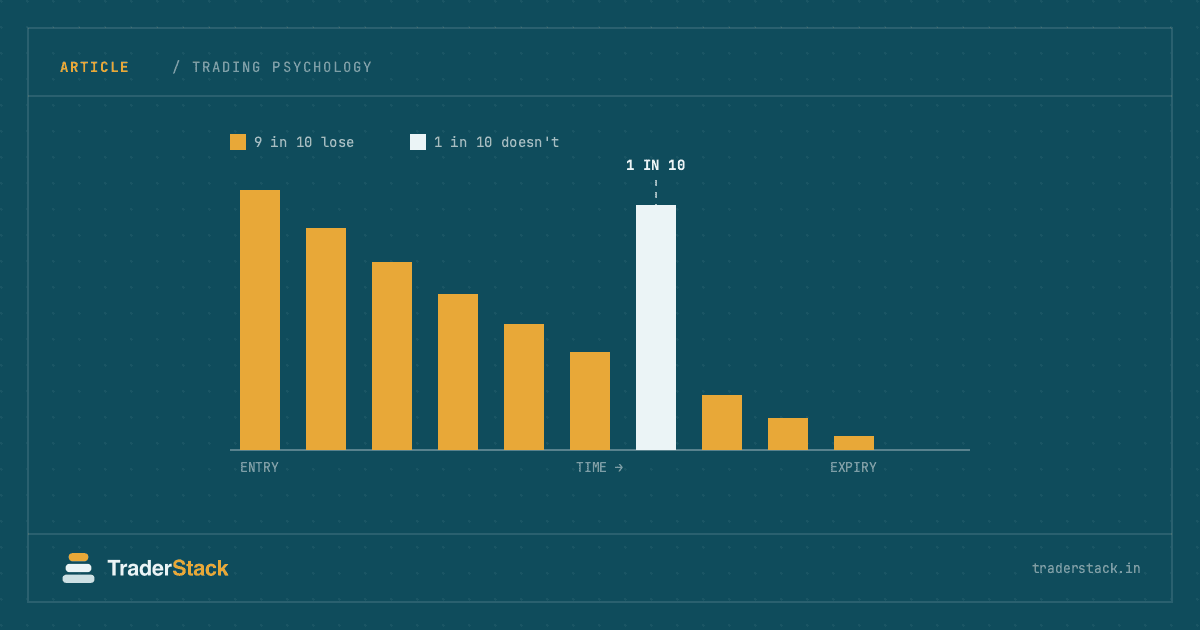
The regulator has actually measured this, twice. A SEBI study covering FY22 to FY24 found that 93% of individual traders in the equity F&O segment lost money over those three years, with combined losses of more than ₹1.8 lakh crore. Only 7.2% managed any profit at all. Just 1% cleared more than ₹1 lakh, after costs.
A follow-up study for FY25 found 91% of individual traders lost money that year alone, averaging a loss of about ₹1.1 lakh each, adding up to ₹1,05,603 crore, itself a 41% jump from the ₹74,812 crore lost the year before. SEBI had already tightened the rules by then, limiting weekly expiries and raising lot sizes specifically to cool this down. The loss rate barely moved, from 93% to 91%. What actually shrank was the number of people willing to keep playing: unique individual traders in the segment fell from about 61.4 lakh in the first quarter of FY25 to 42.7 lakh by the fourth.
Key takeaway
SEBI's own data says roughly 9 out of 10 individual F&O traders lose money, and that number has barely moved across two separate studies even after the regulator intervened. It comes straight from the regulator measuring its own market, twice, and getting the same answer both times.
It's Not That They Picked the Wrong Direction
The easy assumption is that these are just bad predictions: 9 out of 10 people guessed which way NIFTY would move and got it wrong. The actual mechanism is more specific than a wrong guess, and it's worth understanding, because once you see it, it's hard to unsee.
When you buy a call option (a bet that pays off if the underlying moves up before expiry), you're paying a premium made of two things: intrinsic value, what the option would be worth if you exercised it right now, and time value, what someone's willing to pay for the chance that it becomes worth more before it expires. Time value is the part that matters here, because it shrinks every single day you hold the option, whether NIFTY goes up, goes down, or does nothing at all. Traders call this decay theta, and it isn't gentle. It behaves like an ice cube left on the kitchen counter: barely noticeable in the first hour, then gone a lot faster than you'd expect once you're close to the end.
That means buying an option is never just a bet on direction. It's a bet on direction, magnitude, and timing, all three, inside a window that's shrinking from the moment you click buy. Getting the direction right isn't enough if the move doesn't happen fast enough, or big enough, before decay eats the premium.
This cuts one way. Time decay works against the option buyer and in favor of the option seller, which is a big part of why more experienced participants often prefer writing options over buying them. Selling options carries far larger, sometimes technically unlimited, downside and margin requirements that most beginner accounts have no business carrying, so the honest takeaway here is to understand that the clock works against a buyer by default, not to casually flip to selling as a fix.
The Hidden Tax Nobody Budgets For
There's a second force working against the average F&O trader, and it's less dramatic than time decay but just as real: every single trade costs something, win or lose, and those costs compound with frequency.
Here's what actually gets deducted on a typical options trade, at the rates in force at the time of writing:
Per-Trade Cost = Brokerage + STT + Exchange Charges + Stamp Duty + SEBI Fee + GST
- Brokerage
- A flat fee per executed order, around ₹20 at most discount brokers
- STT
- 0.15% of premium value, charged only when you sell or when an option is exercised, never on the buy
- Exchange Charges
- About 0.035% of premium value on NSE, charged on both the buy and sell leg
- Stamp Duty
- 0.003% of premium value, charged only on the buy leg
- SEBI Fee
- ₹10 per crore of turnover, both legs, effectively negligible at retail size
- GST
- 18% on brokerage, exchange charges, and the SEBI fee only, not on STT or stamp duty
None of these look big on their own. That's exactly the problem. SEBI's own FY22-FY24 study put a number on what they add up to: of the 7.2% of individual traders who were profitable at all over three years, only 1% cleared more than ₹1 lakh after adjusting for exactly these costs. A lot of traders who were technically up on their raw trades ended up flat or down once every order got its ₹20-plus-taxes taken out. Trade five times a day chasing setups, and you're paying that cover charge five times a day, before you've won or lost a single rupee on direction.
Let's Watch a Real Trade Lose Money
Ankit is 23, a year into his first job in Guwahati, and has been trading small amounts in F&O for a few months after a friend's group chat turned into a habit. It's an RBI policy morning, and NIFTY is hovering near 22,500. Ankit is fairly confident the central bank will cut rates, so he buys 1 lot, 65 quantity (NIFTY's lot size at the time of writing, so check the live figure before you trade, since exchanges revise these), of a slightly out-of-the-money call at a premium of ₹140. That's ₹9,100 out of his account.
RBI does cut rates. Ankit is right. NIFTY inches up to around 22,550 over the next two days, a real but modest move, because a cut was already widely expected and a lot of that expectation was already priced into the market before the announcement, a pattern traders call buy the rumor, sell the news. The premium on Ankit's call, which was inflated beforehand by uncertainty about the decision, deflates hard once that uncertainty is gone, on top of two more days of ordinary time decay. By the time he exits, the premium has fallen to ₹58.
| Buy (entry) | Sell (exit, two days later) | |
|---|---|---|
| NIFTY level | ~22,500 | ~22,550 |
| Premium | ₹140 | ₹58 |
| Value at 65 qty | ₹9,100 | ₹3,770 |
That's a loss of ₹5,330 on the premium alone, before a single charge. Add brokerage, STT, exchange charges, stamp duty, and GST on both legs (roughly ₹58 all in, using the rates above) and Ankit is down close to ₹5,390, well over half of what he put in, on a trade where his call on direction was correct.
This isn't a dramatized worst case. It's the exact mechanism from the last two sections, time decay plus a volatility crush around a known event, playing out in one ordinary trade. Multiply this by a few trades a week for a year, and you're looking at the shape of that 91% figure, not an unlucky outlier inside it.
What People Get Wrong About This
I lost because I picked the wrong direction, I just need to read charts better.
Ankit picked the right direction and still lost. Direction is one of at least three things, direction, magnitude, and timing, an option buyer has to get right inside the same shrinking window.
I'm not using leverage, I paid the full premium with my own money.
You didn't take a margin loan, true, but a small move in the underlying can erase most of that premium in hours. That concentrated swing is the leverage. It's just built into the payoff instead of a margin call.
The 10% who profit must know some secret setup or indicator.
SEBI's numbers don't point to a secret setup. What separates consistently profitable retail traders is usually mundane: they trade less often, size positions smaller relative to their capital, and treat a loss as an expected cost of the business instead of something to immediately win back.
If I'd just held on longer, it would have recovered.
Time decay doesn't pause while you wait it out. The longer a losing option sits in your account, the more of its remaining time value melts away, whether or not your original view eventually turns out right.
There is no secret indicator hiding in a paid Telegram channel. If there were, SEBI's number wouldn't still say 91%.
Where to Go From Here
None of this means F&O is unplayable. The roughly 1 in 10 who come out ahead are proof it isn't, and plenty of people use options for genuinely defined, hedged purposes rather than a direction lottery. It means the reasons most people lose are specific, mechanical, and mostly foreseeable once you understand what you're actually paying for when you buy an option: how much of that premium is time value, and how fast it's built to shrink.
That's genuinely worth thirty minutes before your next trade.